Conventional sewage treatment plant involves three stages, called primary, secondary and tertiary treatment.
First,with conventional sewage treatment plant
the solids are separated from the wastewater stream. Then
dissolved biological matter is progressively converted into
a solid mass by using indigenous, water-borne micro-organisms.
Finally, the biological solids are neutralized then disposed
of or re-used, and the treated water may be disinfected chemically
or physically (for example by lagoons and microfiltration).
The final effluent can be discharged into a stream, river, bay, lagoon or wetland, or it can be used for the irrigation of a golf course, green way or park. If it is sufficiently clean, it can also be used for groundwater recharge or agricultural purposes
Pre-treatment
Pre-treatment conventional sewage treatment plant
removes the materials that can be easily collected from the
raw wastewater and disposed of. The typical materials that
are removed during pre treatment include fats, oils, and greases
(also referred to as FOG), sand, gravels and rocks (also referred
to as grit), larger settleable solids and floating materials
(such as rags and flushed feminine hygiene products).
Pre treatment also typically includes a sand or grit channel or chamber where the velocity of the incoming wastewater is carefully controlled to allow sand grit and stones to settle, while keeping the majority of the suspended organic material in the water column. Sand, grit, and stones need to be removed early in the process to avoid damage to pumps and other equipment in the remaining treatment stages.
Preliminary treatment processes include coarse screening, medium screening, shredding of solids, flow measuring, pumping, grit removal, and pre-aeration. Chlorination of raw wastewater sometimes is used for odor control and to improve settling characteristics of the solids.
Primary treatment
Sedimentation
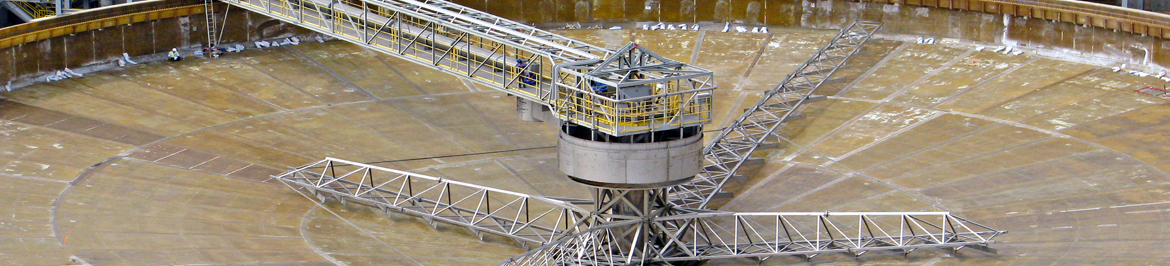
In the primary sedimentation stage conventional sewage treatment plant, sewage flows through
large tanks, commonly called "primary clarifiers" or "primary
sedimentation tanks". The tanks are large enough that sludge
can settle and floating material such as grease and oils can
rise to the surface and be skimmed off. The main purpose of
the primary sedimentation stage is to produce both a generally
homogeneous liquid capable of being treated biologically and
a sludge that can be separately treated or processed. Primary
settling tanks are usually equipped with mechanically driven
scrapers that continually drive the collected sludge towards
a hopper in the base of the tank from where it can be pumped
to further sludge treatment stages.
Secondary treatment
Secondary treatment of conventional sewage treatment plant is designed to substantially degrade
the biological content of the sewage such as are derived from
human waste, food waste, soaps and detergent. The majority
of municipal plants treat the settled sewage liquor using
aerobic biological processes. For this to be effective, the
biota require both oxygen and a substrate on which to live.
There are a number of ways in which this is done. In all these
methods, the bacteria and protozoa consume biodegradable soluble
organic contaminants (e.g. sugars, fats, organic short-chain
carbon molecules, etc.) and bind much of the less soluble
fractions into floc. Secondary treatment system commonly employs
an Aeration Tank wherein microorganism culture completely
degrades organic as well as inorganic impurities in the presence
of either Surface Aerators or Diffused Aeration system.
Secondary sedimentation
The final step in the secondary treatment conventional sewage treatment plant stage is to settle out the biological floc or filter material and produce sewage water containing very low levels of organic material and suspended matter.
Tertiary treatment
The purpose of tertiary treatment of conventional
sewage treatment plant is to provide a final treatment
stage to raise the effluent quality before it is discharged
to the receiving environment (sea, river, lake, ground, etc.).
More than one tertiary treatment process may be used at any
treatment plant. If disinfection is practiced, it is always
the final process. It is also called "effluent polishing".