When does a standard effluent treatment plant stop being enough — and when do water-stressed consent conditions push food and beverage factories toward Zero Liquid Discharge (ZLD)?
Why Regulatory Compliance Matters Now
Dairy, brewery, and wider food & beverage processing plants sit at the intersection of two shifting regulatory realities across India:
- Fixed statutory discharge standards under the Environment (Protection) Rules, 1986 and Central Pollution Control Board (CPCB) / SPCB consent conditions.
- Escalating pressure for Zero Liquid Discharge (ZLD) — already an absolute mandate for distillery spent wash, and increasingly written into Consent to Operate (CTO) renewals for large food-processing units in water-stressed, critically exploited groundwater districts.
For plant heads, EHS managers, and EPC project buyers, the operational question is no longer just “Can our ETP meet BOD 30?” It is “Will our next CTO renewal still permit any liquid discharge to the environment?”
What Dairy & Beverage Wastewater Actually Looks Like
Raw effluent from food and beverage operations is high-strength, biologically active, and subject to intense hourly fluctuations:
| Industrial Stream | Typical Raw BOD (mg/L) | Typical Raw COD (mg/L) | Key Treatment Challenges |
|---|---|---|---|
| Dairy Processing (Milk, Paneer, Ghee) | 500 – 3,500 | 1,000 – 8,000 | High fat/oil/grease (FOG), lactose, proteins, and sharp CIP caustic/acid swings. |
| Brewery & Beverage Bottling | 300 – 4,000 | 600 – 5,000 | Spent yeast, residual sugars, grain suspended solids, and low pH washdowns. |
| Distillery Spent Wash (Vinasse) | 40,000 – 60,000+ | 80,000 – 100,000+ | Extreme organic load, recalcitrant dark color; absolute zero environmental discharge. |
Dairy BOD is heavily driven by dissolved milk solids and fats. Clean-in-Place (CIP) cycles generate sharp pH swings (hot caustic washes alternating with nitric acid rinses). Breweries generate moderate-to-high organic loads with spent yeast and sugars. Distillery spent wash operates in a separate regulatory stratosphere — which is why CPCB enforces an absolute no-discharge mandate.
Core CPCB & Environment (Protection) Rules Limits
For industrial units discharging treated effluent, the statutory baseline parameters under Environment (Protection) Rules, 1986 are:
| Parameter | Inland Surface Water | Land for Irrigation | Municipal Sewer (Typical) |
|---|---|---|---|
| pH Range | 6.5 – 8.5 | 5.5 – 9.0 | 5.5 – 9.0 |
| BOD (3-day at 27°C) | ≤ 30 mg/L | ≤ 100 mg/L | ≤ 350 mg/L |
| COD | ≤ 250 mg/L | — | — |
| Total Suspended Solids (TSS) | ≤ 100 mg/L | ≤ 200 mg/L | ≤ 600 mg/L |
| Oil & Grease (FOG) | ≤ 10 mg/L | ≤ 10 mg/L | ≤ 20 mg/L |
Dairy-Specific Schedule Notes:
- Under CPCB industry-specific schedules, dairy effluent BOD standards historically allowed up to 100 mg/L in specific land applications.
- However, when discharging into a water body used as a downstream drinking water source, the limit is strictly tightened to ≤ 30 mg/L.
- State Pollution Control Boards (SPCBs) like GPCB, MPCB, TNPCB, and RSPCB regularly prescribe the stricter BOD ≤ 30 mg/L, COD ≤ 250 mg/L inland standard across all CTO consents.
- Oil & grease must never exceed 10 mg/L to prevent oxygen starvation in receiving waterways.
Distillery vs. Dairy vs. Brewery — Who Must Implement ZLD?
1. Distilleries (Spent Wash)
CPCB’s 2017 directions (reinforced by multiple National Green Tribunal orders) are unambiguous: zero spent wash may be discharged into surface water, land, or sub-surface aquifers — treated or untreated.
Approved compliance trains require biomethanation (biogas recovery) followed by Multiple Effect Evaporator (MEE) concentration and bio-composting or incineration boiler firing. Treated condensate discharged from secondary units must still meet the inland ≤ 30 mg/L BOD standard.
2. Breweries
Most brewery wastewater can be treated to full discharge compliance through a modern biological Effluent Treatment Plant (ETP) combining screening, equalisation, primary DAF, and aerobic MBBR/SBR systems. While there is no blanket national ZLD mandate for all breweries, units in water-stressed industrial clusters (such as Aurangabad, Bengaluru rural, or parts of Rajasthan) face mandatory internal recycling clauses in CTO renewals.
3. Dairies & Food Processing Facilities
No uniform nationwide ZLD mandate exists for all dairy units. In practice, however, large plants located in over-exploited groundwater blocks are receiving ZLD or 100% water recycle mandates. The primary driver is local aquifer depletion and cumulative industrial load rather than effluent toxicity alone.
What a Compliant Dairy / Beverage ETP Train Contains
A generic municipal-style wastewater plant will quickly fail in a food factory due to severe fat solidification and CIP chemical shocks. A purpose-engineered industrial ETP train features:
- Coarse & Fine Screening: Intercepting plastic seals, packaging labels, curd lumps, and grain husks.
- Equalisation & Automated pH Buffering: Large-volume buffer tanks to normalize hot alkaline/acid CIP slug discharges.
- Dissolved Air Flotation (DAF): Essential for separating emulsified milk fats, butter, and ghee oils down to ≤ 10 mg/L before biological aeration.
- High-Rate Biological Aeration: Utilizing MBBR (Moving Bed Biofilm Reactor) or SBR (Sequential Batch Reactor) to digest dissolved lactose, starches, and proteins down to BOD ≤ 30 mg/L and COD ≤ 250 mg/L.
- Tertiary Media Polishing: Dual Media Filters and Activated Carbon Filters for final suspended solids capture and odor removal.
- Whey Segregation & Recovery: Concentrated cheese/paneer whey should be segregated upstream for lactose/protein recovery or anaerobic biomethanation rather than overwhelming the aerobic ETP.
When “ETP Only” Is No Longer Enough — The ZLD Transition
Transitioning from a compliant ETP to a Zero Liquid Discharge (ZLD) System becomes the logical (or regulatory-forced) step when:
- The SPCB writes a “Zero Liquid Discharge / 100% Internal Recycle” condition into the CTO.
- Freshwater borehole extraction quotas are capped, meaning factory expansion requires internal water reuse.
- Corporate ESG and water-positivity mandates require circular water recycling.
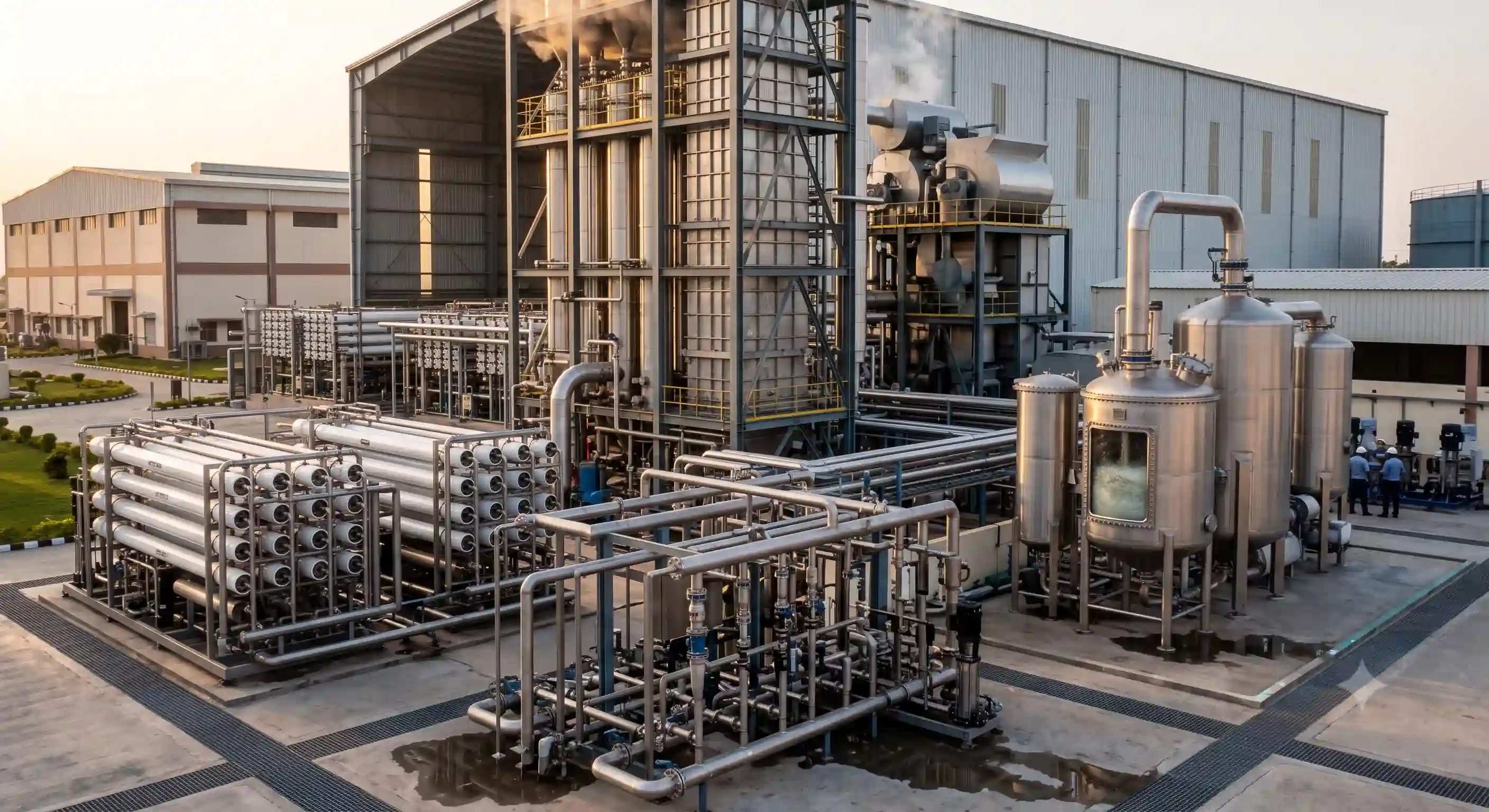
A Complete ZLD Expansion Train Incorporates:
- Ultrafiltration (UF) Polishing: Removing colloidal organics and SDI (Silt Density Index) prior to membrane desalting.
- Multi-Stage Reverse Osmosis (RO): Generating 85–90% high-purity permeate water for cooling tower makeup and boiler feed. Explore our Industrial RO Plants.
- Thermal Evaporation (MEE + ATFD): Evaporating the small RO reject volume to crystallize solid salts, leaving zero liquid discharge to the environment.
Practical Checklist for Plant & EHS Managers
Factory Compliance & Engineering Checklist
How Shubham India Supports Food & Beverage Plants
Shubham Aqua Vitro Pvt. Ltd. delivers turnkey, custom-engineered water and wastewater solutions across India:
- Effluent Treatment Plants (ETP): Purpose-built for dairy FOG, whey COD, and brewery washdowns, consistently beating CPCB discharge limits.
- Zero Liquid Discharge (ZLD) Systems: Robust ETP + RO + MEE/ATFD packages designed to deliver 95%+ water recovery with optimized operational expenditure.
- Process & Boiler Feed Water Treatment: Reverse osmosis and softening plants that enable recovered water to offset freshwater procurement.
- RO Plants on Rent: Fast-deploy containerized membrane units for seasonal processing surges and temporary capacity expansion.
Upgrading Your Dairy or Beverage Treatment Plant?
Connect with Shubham Aqua Vitro for comprehensive effluent characterization, ETP modernization, and turnkey Zero Liquid Discharge engineering tailored to your CTO consent requirements.
Regulatory Sources & References:
- Central Pollution Control Board (CPCB) Official Portal
- CPCB Dairy Effluent Schedule — Environment (Protection) Rules, 1986
- CPCB Effluent Discharge Standards Digest (2025–2026)
- CPCB Sector-Wise ZLD Mandate Overview
- Food Safety and Standards Authority of India (FSSAI): Schedule 4 — General Hygienic and Sanitary Practices for Food Business Operators