Pharmaceutical & Life Sciences Water Treatment Systems
In pharmaceutical formulations, sterile injectables, Active Pharmaceutical Ingredients (APIs), and biotechnology manufacturing, high-purity water is the primary solvent, excipient, and critical process utility. Shubham Aqua Vitro engineers turnkey Purified Water (PW) Generation Skids and sanitary storage-distribution loops conforming strictly to USP 43, IP 2022, European Pharmacopoeia (Ph. Eur.), and WHO cGMP standards.
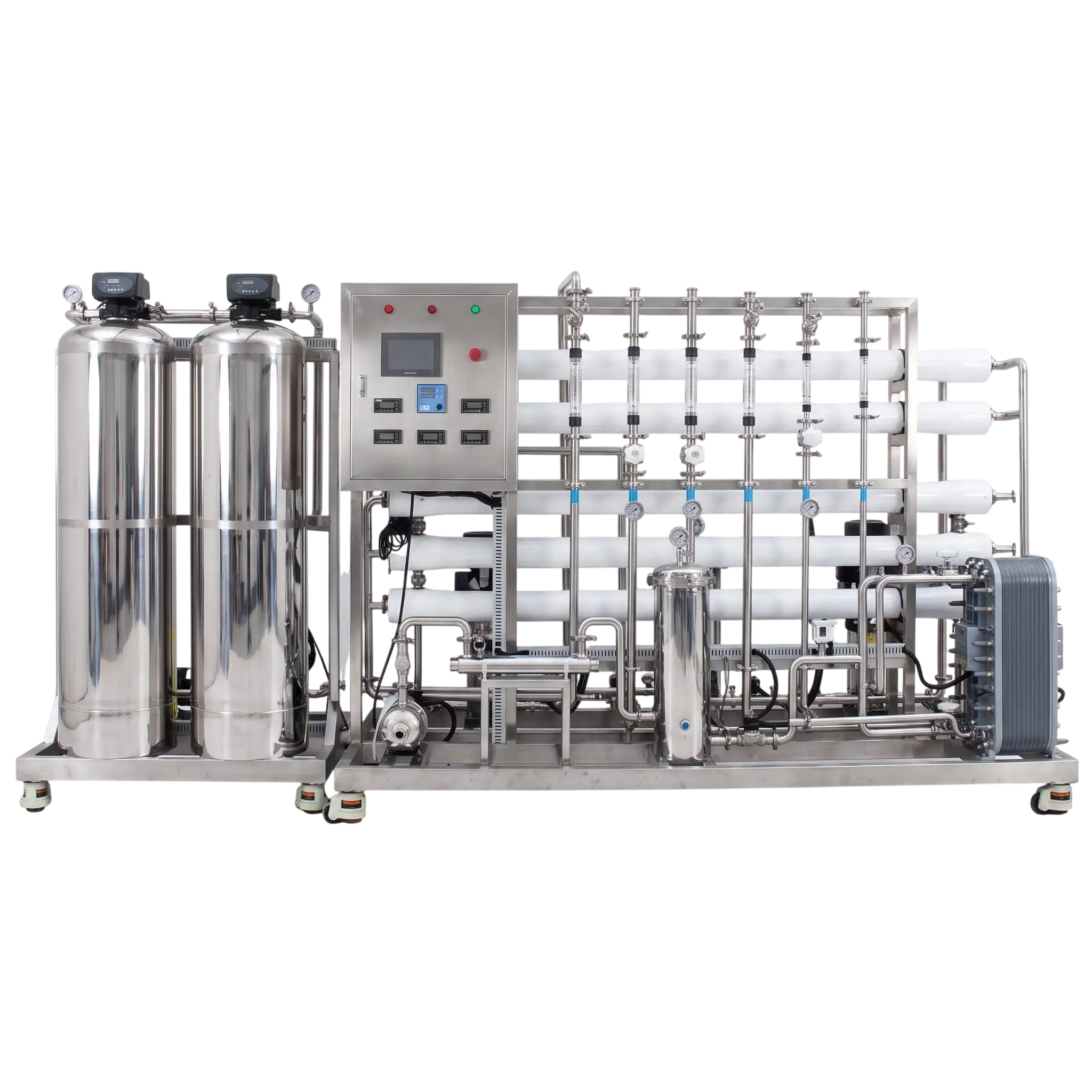
Our engineered systems combine Double-Pass Reverse Osmosis (RO) with continuous Electro-Deionization (EDI), 185nm UV Total Organic Carbon (TOC) reduction, and automated 85°C Hot Water Sanitization (HWSR). Every unit is constructed with orbital-welded SS 316L sanitary piping (Ra < 0.4 µm), zero dead-leg diaphragm valve blocks (3D/1.5D rule), and 21 CFR Part 11 compliant SCADA automation.
Available in skid-mounted capacities from 500 LPH to 20,000 LPH, Shubham pharmaceutical water solutions come backed by complete Design, Installation, Operational, and Performance Qualification (DQ/IQ/OQ/PQ) documentation packages ready for USFDA, EU GMP, and MHRA regulatory audits.
Purified Water (PW) Generation & Sanitization Principle
Raw water undergoes multi-stage pretreatment (depth filtration, softening, and anti-scalant conditioning) before entering the primary sanitary RO pass. The permeate is conditioned with membrane degassing to strip dissolved CO2, then polished through a secondary high-rejection sanitary RO pass. Continuous Electro-Deionization (EDI) removes residual trace electrolytes down to < 0.8 µS/cm without chemical regeneration. Dual-wavelength UV radiation (185nm & 254nm) destroys trace organics and microorganisms. The purified water is continuously recirculated at turbulent velocity (> 1.5 m/s) in an electropolished SS 316L loop, backed by automated 85°C thermal sanitization routines to maintain zero microbial bioburden.
Technical Specification
Engineering parameters and hardware configurations for Shubham Pharmaceutical Double-Pass RO + EDI Purified Water Generation skids:
| System Capacity | 500 LPH to 20,000 LPH (Custom skid modular units) |
| Process Technology | Double-Pass RO (Sanitary TFC) + Continuous Electro-Deionization (EDI) |
| Conductivity (@ 25°C) | < 1.0 µS/cm (Guaranteed online typical < 0.8 µS/cm) |
| Total Organic Carbon (TOC) | < 200 ppb (integrated with dual 185nm UV TOC reduction) |
| Microbial Limits | < 10 CFU / 100 mL (exceeding USP & IP requirement of < 100 CFU/mL) |
| Bacterial Endotoxins | < 0.03 EU / mL (with optional Point-of-Use Ultrafiltration polishing) |
| Material of Construction (Wetted) | SS 316L (AISI 316L) with internal Electro-Polishing (Ra < 0.4 µm / 15 µin) |
| Material of Construction (External) | SS 304 / SS 316 Satin / Mirror Finish (Ra < 0.8 µm) |
| Piping & Welding Standard | Orbital TIG automatic welding with 100% Boroscopy video inspection & weld maps |
| Sanitary Valve Construction | Zero dead-leg T-block & Two-way Diaphragm Valves (3D / 1.5D rule compliant) |
| Sanitization System | Automated Hot Water Thermal Sanitization (85°C HWSR Routine) |
| Degassing System | Sanitary Membrane Contactor for dissolved CO2 stripping (protecting EDI) |
| Instrumentation | Sanitary Triclamp Online Conductivity, TOC Analyzer, Flow, Temp & Pressure Sensors |
| Automation & Controls | Siemens S7-1500 / Allen-Bradley PLC with SCADA, 21 CFR Part 11 Audit Trail & E-Signatures |
| Storage & Loop Design | Continuous turbulent recirculation velocity (> 1.5 m/s) with 0.2 µm hydrophobic vent filters |
Pharmacopeial Purity Standards Comparison
Comparison of global pharmacopoeia requirements against water quality parameters delivered by Shubham Purified Water generation skids:
| Purity Parameter | USP 43 Standard | IP 2022 Standard | Ph. Eur. Standard | Shubham Delivered Quality |
| Conductivity (@ 25°C) | ≤ 1.3 µS/cm | ≤ 1.3 µS/cm | ≤ 4.3 µS/cm (at 20°C) | < 0.8 µS/cm (Typical 0.1 – 0.5 µS/cm) |
| Total Organic Carbon (TOC) | < 500 ppb | < 500 ppb | < 500 ppb | < 200 ppb (with 185nm UV) |
| Microbial Count (CFU) | ≤ 100 CFU / mL | ≤ 100 CFU / mL | ≤ 100 CFU / mL | < 10 CFU / 100 mL |
| Bacterial Endotoxins | < 0.25 EU / mL (if tested) | < 0.25 EU / mL | < 0.25 EU / mL | < 0.03 EU / mL (with UF module) |
| Heavy Metals / Lead | ≤ 0.1 ppm | ≤ 0.1 ppm | ≤ 0.1 ppm | Undetectable (Below detection limit) |
| Nitrates (NO3) | ≤ 0.2 ppm | ≤ 0.2 ppm | ≤ 0.2 ppm | < 0.05 ppm |
System Process Flow & Architecture
1. Pre-Treatment Train
Raw water is processed through Multigrade Filters (MGF), Activated Carbon Filters (ACF), and twin-alternating duplex softening or continuous anti-scalant dosing to eliminate SDI, chlorine, and hardness scale.
2. Double-Pass Sanitary RO
Primary RO removes 98–99% of dissolved solids and colloids. The permeate enters a membrane contactor for dissolved CO2 degasification before passing through the secondary high-rejection sanitary RO pass.
3. Electro-Deionization (EDI)
Continuous EDI module uses DC voltage and ion-selective membranes to remove residual ionized minerals down to < 0.8 µS/cm continuously without hazardous acid/alkali chemical regeneration.
4. Dual UV & Endotoxin Polishing
TOC reduction UV chamber (185 nm) cleaves organics while germicidal UV (254 nm) ensures bioburden control. Sub-micron sanitary ultrafiltration polishers guarantee endotoxin-free effluent < 0.03 EU/mL.
5. SS 316L Distribution Loop
Storage tanks with 0.2 µm hydrophobic vent filters and nitrogen blanketing feed orbital-welded SS 316L (Ra < 0.4 µm) loops maintained at constant turbulent velocity (> 1.5 m/s) with zero dead-legs.
6. Automated 85°C Thermal Sanitization
Programmable PLC-driven Hot Water Sanitization Routine (HWSR) circulates 85°C superheated sanitary water through RO membranes, EDI, and loop piping on set maintenance schedules, eliminating biofilm.
Salient Features
- SS 316L Sanitary Metallurgy: All wetted product contact surfaces fabricated in AISI SS 316L, internally electropolished to Ra < 0.4 µm (15 µin) to prevent bacterial adherence.
- Orbital TIG Welding & 100% Boroscopy: Automatic enclosed orbital welding with complete boroscopic video inspection logs, isometric weld mapping, and purge-gas documentation.
- Zero Dead-Leg Design: Distribution valves and branch manifolds strictly conform to the 3D / 1.5D zero dead-leg pharmacopeial design rule.
- Automated 85°C Hot Water Sanitization (HWSR): Built-in sanitary heat exchanger allows periodic automated thermal sanitization across membranes, EDI, and loop piping without chemical residues.
- 21 CFR Part 11 Compliant Automation: Siemens / Allen-Bradley PLC control system with password-tiered access, audit trail, automated alarms, electronic batch records, and SCADA connectivity.
- Online Analytical Instrumentation: Tri-clamp sanitary online conductivity sensors, dual-channel TOC analyzers, sanitary flow meters, pressure transmitters, and temperature sensors.
- Automatic Off-Spec Water Rejection: High-speed automated sanitary dump valves immediately divert any off-spec water to drain if conductivity or TOC thresholds are breached.
- Complete Skid-Mounted Modular Architecture: Factory assembled, piped, pre-wired, and wet-tested to reduce on-site civil and installation turnaround times.
Benefits for Pharmaceutical & Life Sciences Manufacturers
- Guaranteed Regulatory Audit Clearance: Built from the ground up to clear USFDA, EU GMP, WHO, MHRA, and CDSCO regulatory audits without deviation observations.
- Continuous Chemical-Free Operation: Continuous Electro-Deionization (EDI) eliminates acid and caustic hazardous chemical handling, storage, and regeneration downtime.
- Complete Biofilm & Bioburden Prevention: Smooth Ra < 0.4 µm internal surface finish and periodic 85°C thermal sanitization completely eliminate biofilm colonization.
- Low Total Cost of Ownership (TCO): High water recovery rates (up to 80–85%), energy-efficient sanitary pumps, and automated controls minimize utility power and water consumption.
- Turnkey Validation Vault Included: Eliminates regulatory approval delays with complete DQ, IQ, OQ, and PQ validation protocols, FAT/SAT reports, and calibration certificates.
- Decades of Engineering Experience: Backed by Shubham Aqua Vitro’s extensive track record in supplying high-purity water infrastructure to leading pharma leaders across Gujarat and India.
Industry Applications & Sub-Sectors
Shubham Pharmaceutical & Life Sciences systems serve critical manufacturing and laboratory workflows:
Bulk APIs & Chemical Synthesis
High-volume demineralized and purified water for Active Pharmaceutical Ingredient reaction vessels, chemical synthesis, purification, crystallization, and reactor CIP/SIP washing.
Oral Solid Dosage (OSD)
Purified water for granulation, coating solutions, tablet formulation, capsule compounding, suspension preparation, and equipment washrooms.
Sterile Injectables & Parenterals
High-purity pretreatment and feed water for Water for Injection (WFI) multi-column distillation stills and Pure Steam Generators (PSG).
Biotechnology & Vaccines
Ultra-pure endotoxin-controlled process water for fermentation media, cell culture broth preparation, chromatography buffer compounding, and sterile filtration.
Diagnostic Reagents & Medical Devices
Consistent low-TOC (< 200 ppb) and low-conductivity water for clinical in-vitro diagnostic test kits, cleanroom ultrasonic washing, and optical device rinse loops.
R&D Laboratories & QC Testing
Type 1 and Type 2 ultra-pure water distribution systems for HPLC, LC-MS, dissolution testing, TOC calibration, and analytical microbiology laboratories.
Validation Vault & Documentation (DQ / IQ / OQ / PQ)
Every pharmaceutical water project executed by Shubham India includes a comprehensive cGMP validation documentation package:
| Design Qualification (DQ) | System P&ID, Functional Design Specification (FDS), Hardware/Software Design Specifications (HDS/SDS), 3D Isometric Piping Drawings, Zero Dead-Leg Verification Reports. |
| Installation Qualification (IQ) | Material Test Reports (MTR 3.1 Mill Certificates), Boroscopy Video Logs & Weld Maps, Surface Roughness (Ra) Profilometer Reports, Hydrostatic Pressure Test Logs, Instrument Calibration Certificates. |
| Operational Qualification (OQ) | Automation Functional Testing, 21 CFR Part 11 Audit Trail & Alarm Verification, Thermal Sanitization Cycle Validation (85°C temperature hold logging), Automatic Dump Valve Diversion Tests. |
| Performance Qualification (PQ) | Phase 1 (14-day daily sampling), Phase 2 (14-day intensive multi-point testing), and Phase 3 (1-year ongoing validation protocol) chemical & microbial testing matrix. |
| FAT & SAT Execution | Full Factory Acceptance Testing (FAT) with wet simulation at Shubham facility prior to dispatch, followed by formal Site Acceptance Testing (SAT) and commissioning. |
Frequently Asked Questions (FAQ)
01.Why is Double-Pass RO + EDI required instead of Single-Pass RO?
Single-pass RO cannot consistently guarantee conductivity below 1.3 µS/cm across varying seasonal feedwater temperatures and raw water TDS. A double-pass RO provides dual physical membrane barriers, and coupling it with continuous Electro-Deionization (EDI) removes remaining dissolved ions and CO2 to achieve conductivity < 0.8 µS/cm without chemical regeneration.
02.What validation documentation (DQ/IQ/OQ/PQ) is provided for audits?
Every Shubham system includes a complete validation vault conforming to cGMP and USFDA standards: Design Qualification (DQ), Installation Qualification (IQ), Operational Qualification (OQ), and Performance Qualification (PQ), along with boroscopic weld logs, material test certificates (MTRs), calibration certificates, and 21 CFR Part 11 automation documentation.
03.How does automated hot water sanitization (HWSR) eliminate bioburden?
Biofilms are resistant to standard chemical rinses. Shubham India integrates automated hot water sanitization at 85°C across the RO membranes, EDI modules, storage tanks, and SS 316L distribution loops on a programmable timer, achieving thermal sanitization with zero chemical residue.
04.What surface roughness (Ra) standards are maintained for wetted parts?
All product contact parts (tubing, valves, pump casings, storage vessels) are fabricated from SS 316L with internal electropolishing to Ra < 0.4 µm (15 µin). Non-contact external surfaces are mechanical polished to Ra < 0.8 µm to eliminate crevice corrosion and bacterial adhesion.