
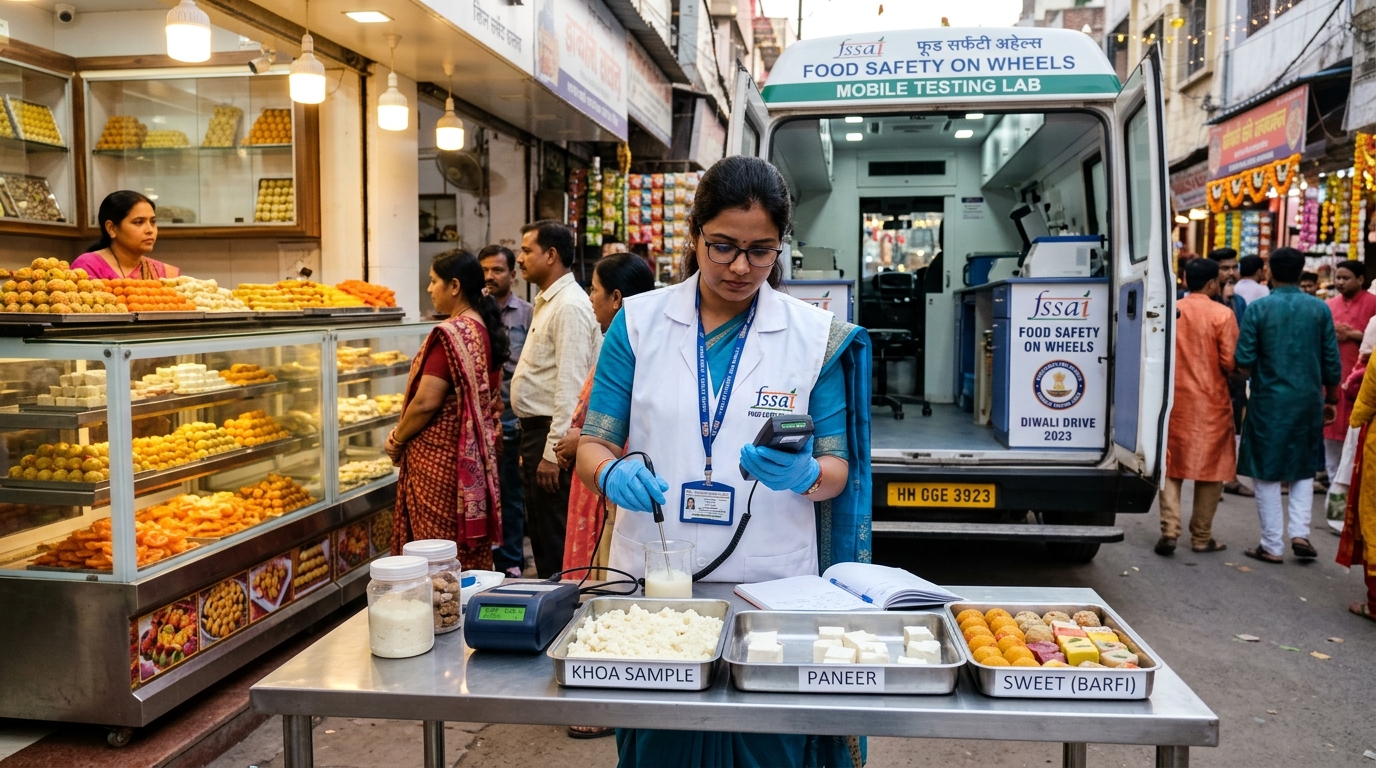
Every year, as Navratri and Diwali approach, consumer demand for sweets, milk products, ghee, khoa, paneer, edible oils, and packaged beverages spikes dramatically across India. With surging demand comes heightened commercial pressure — leading to an alarming seasonal influx of synthetic dairy, counterfeit oils, industrial dyes, and unhygienic manufacturing practices.
This comprehensive guide examines the specific mandates of the 2026 directive, the high-scrutiny food commodities, the deployment of rapid mobile laboratories, the newly enforced cold-chain mandates, and the crucial yet often overlooked role of process water quality and hygiene in commercial food manufacturing compliance.
Central mandate to all State & UT Food Safety Commissioners to initiate immediate surveillance.
Mobile testing vans deployed in major wholesale hubs for instant on-the-spot screening.
Inspection findings, seizure logs, and lab outcomes digitally tracked to ensure enforcement transparency.
What Exactly Did FSSAI Direct for Festive 2026?
In its directive dated 29 September 2026, the Regulatory Compliance Division of FSSAI instructed State authorities to implement a multi-layered surveillance protocol:
- Unannounced Inspections & Strategic Sampling: Designated Officers (DOs) and Food Safety Officers (FSOs) must conduct rigorous sampling drives targeting both registered manufacturing establishments and informal wholesale supply hubs.
- Hotspot and Intelligence-Led Targeting: Enforcement teams are tasked with mapping vulnerable supply nodes — including border check-posts, cold-storage warehouses, bus and railway transshipment points, and bustling festive bazaars.
- Mobile Laboratory Deployment: Food Safety on Wheels (FSWs) — specialized vans outfitted with rapid testing gear — are deployed across prominent market locations to perform rapid screening of milk solids and cooking oils.
- Digital Real-Time Accountability: Every inspection, sampling event, and seizure must be uploaded directly to the FoSCoS (Food Safety Compliance System) and FoSCoRIS (Food Safety Compliance through Regular Inspection and Sampling) portals.
High-Scrutiny Festive Commodities & Common Adulterants
The regulator has singled out six core high-demand categories for intensified scrutiny during Navratri and Diwali:
| Product Category | Festive Examples | Target Adulterants & Risks | Surveillance Focus |
|---|---|---|---|
| Milk & Milk Products | Khoa / Mawa, Paneer, Desi Ghee, Cream, Fresh Milk | High Risk Synthetic milk, urea, detergent, starch, palm oil blending, sub-standard milk fat | Fat & SNF testing, qualitative chemical strip screening, cold chain temperature compliance |
| Traditional Sweets | Barfi, Gulab Jamun, Rasgulla, Kaju Katli, Ladoos | Non-permitted industrial dyes (Metanil Yellow, Rhodamine B), rancid fats, stale rework | Synthetic color chromatography, microbiological hygiene, Best Before date verification |
| Edible Oils & Fats | Mustard oil, refined soy oil, Vanaspati, blended cooking oils | Argemone oil contamination, prohibited mineral oils, reused oil with high polar compounds | Total Polar Compounds (TPC ≤ 25%), fatty acid profile analysis, Bellier turbidity test |
| Snacks & Savouries | Namkeen, farsan, chakli, papad, fryums | Substandard frying mediums, non-permitted colors, high moisture rancidity | Acid value of extracted oil, packaging integrity, moisture and hygiene testing |
| Packaged Beverages | Soft drinks, fruit beverages, packaged drinking water | Microbial Risk Coliform contamination, unapproved additives, counterfeit BIS/FSSAI licensing | Microbiological filtration tests, seal security, label and water source verification |
| Fasting / Festive Flours | Kuttu atta (buckwheat), singhada atta (water chestnut) | Fungal mycotoxins, blending with cheap starch, contaminated milling equipment | Microscopic identification, aflatoxin screening, moisture content testing |
Key Operational Fact: State Food Safety Commissioners hold statutory authority under the Food Safety and Standards Act to expand this monitoring list to include regional specialties based on local dietary patterns and intelligence reports.
The October 2026 Cold-Chain & Temperature Advisory
In addition to the 29 September surveillance directive, FSSAI issued an urgent regulatory advisory in mid-October 2026 addressing a pervasive safety flaw: ambient temperature handling of perishable dairy and poultry products.
Traditional sweet manufacturers and retail vendors frequently display mounds of freshly delivered khoa and paneer on open shop counters at warm Indian room temperatures (28°C–35°C). Under these thermal conditions, bacterial pathogens such as Staphylococcus aureus, Bacillus cereus, and Listeria monocytogenes multiply exponentially, releasing heat-stable enterotoxins that cannot be deactivated by subsequent boiling or frying.
Under the latest advisory:
- Khoa and paneer must be maintained at or below 4°C to 8°C across every link of the logistics chain — from farm chilling centers and transit vans to retail display cabinets.
- Shops lacking certified temperature-controlled display cases face product impoundment and cancellation of perishable handling permits.
- Enforcement officers using handheld infrared digital thermometers are conducting spot checks at delivery arrival points.
The Hidden Compliance Threat: Process Water Quality & Hygiene
While market surveillance frequently focuses on raw milk solids and frying oils, seasoned food quality auditors recognize an underlying vulnerability that causes dozens of festive plant closures: process water and plant sanitation hygiene.
In dairy, confectionery, beverage, and namkeen processing, water is not merely a utility — it is a primary ingredient and an essential hygiene vector:
Critical Water Touchpoints in Food & Beverage Plants
- Product Formulation Water: Used directly in syrup preparation, beverage blending, dough kneading, and dairy recombination. Any dissolved chemical impurities (high TDS, heavy metals, hardness) directly degrade product taste and shelf life.
- Clean-in-Place (CIP) Final Rinses: Processing tanks, homogenizers, plate heat exchangers, and filling nozzles undergo automated chemical CIP cleaning. If the final water rinse contains coliforms, biofilms, or excess chlorine, it cross-contaminates entire production batches.
- Ingredient Washing & Blanching: Unfiltered borehole water used to wash vegetables, seeds, or processing equipment introduces microscopic pathogens into finished foods.
- Boiler Feed Water: Steam jackets and autoclaves require demineralized or softened water to prevent boiler tube scale and corrosive carryover into culinary steam.
Under Schedule 4 of the Food Safety and Standards (Licensing and Registration of Food Businesses) Regulations, food establishments must demonstrate that all water contacting food surfaces strictly complies with IS 10500 standards with zero microbiological counts (0 CFU/100 mL of E. coli and coliforms).
Food plants operating sub-standard sand filters or obsolete disinfection equipment risk immediate sample failures and plant closure notices when FSSAI inspectors arrive. Implementing food-grade stainless steel Reverse Osmosis (RO) systems with integrated ultraviolet (UV) and ozone sanitation provides an impermeable compliance shield.
Action Checklist for Food Business Operators (FBOs)
To prepare for surprise festive inspections and ensure uncompromised food safety, food manufacturers and sweet processors should verify these five operational pillars:
FBO Festive Audit Checklist
How Consumers Can Safeguard Festive Purchases
Shoppers can apply practical precautions when purchasing festive treats:
- Examine the 14-Digit FSSAI License: Always check that sweet boxes and packaged oils feature a genuine 14-digit license number and official FSSAI logo.
- Be Skeptical of Unusually Cheap Mithai: Pure mawa, ghee, and dry fruits carry fixed baseline commodity costs. Khoa sold at prices below the raw milk equivalent is almost certainly formulated with skimmed milk powder, starch, and refined vegetable oils.
- Perform the Simple Iodine Starch Test: Take a small sample of khoa or paneer, boil it with a little water, let it cool, and add 2–3 drops of tincture of iodine. A deep blue or purple coloration confirms unauthorized starch or flour adulteration.
- Avoid Overly Radiant, Vibrant Sweets: Unnaturally vivid yellow or fluorescent red sweets often contain banned industrial dyes like Metanil Yellow instead of permissible food colors.
- Utilize the Food Safety Connect App: If you detect foul taste, chemical odors, or unhygienic conditions, report the retailer directly via the FSSAI Food Safety Connect mobile application or call your state food safety commissioner’s toll-free helpline.
Shubham India: Engineered Water & Wastewater Solutions for Food & Beverage Plants
A certified water treatment line and compliant effluent management system are the foundation of regulatory security in modern food processing. Shubham Aqua Vitro provides turnkey engineering solutions tailored for the Indian food and beverage industry:
- Food-Grade RO & Water Purification Skids: Sanitary stainless steel (SS316L) Reverse Osmosis plants designed to eliminate TDS, heavy metals, and organic contaminants, paired with high-dose UV reactors and ozone sanitation loops for 100% microbiological safety. Explore our dedicated Food & Beverage Industry Solutions.
- High-Rate Ultrafiltration (UF) Systems: Hollow-fiber UF systems providing physical pathogen barriers for ingredient wash and municipal supply polishing.
- Dairy & Agro Effluent Treatment Plants (ETP): High-strength dairy wastewater (rich in fats, oils, and milk sugars with high BOD/COD) demands specialized treatment. Shubham designs and installs MBBR and MBR biological systems and high-efficiency Effluent Treatment Plants (ETP) that guarantee full compliance with CPCB discharge limits.
- Zero Liquid Discharge (ZLD) Systems: Turnkey ZLD plants combining membrane recovery and evaporative crystallization, enabling food processors to recover over 95% of wastewater for boiler feed and cooling towers.
Official Regulatory References & Reading
- Food Safety and Standards Authority of India (FSSAI), Letter dated 29.09.2026: Special festive drive to ensure food safety, quality, and prevention of adulteration during festival season, Regulatory Compliance Division, FDA Bhawan, New Delhi.
- FSSAI Regulatory Advisory, Advisory on Cold-Chain and Temperature Maintenance of Perishable Food Commodities (Khoa, Paneer, Meat, Fish) (Mid-October 2026).
- Food Safety and Standards Act, 2006 and Food Safety and Standards (Licensing and Registration of Food Businesses) Regulations, 2011 (Schedule 4 General Hygienic and Sanitary Practices).
- Press Trust of India (PTI) & Business Standard, FSSAI orders nationwide festive food safety surveillance ahead of Diwali (October 2026).
- Bureau of Indian Standards, IS 10500:2012 Drinking Water Specification and IS 14543 Packaged Drinking Water.
Disclaimer: This article is intended for educational and technical information purposes for food manufacturers, processors, and consumers. FBOs should consult official FSSAI gazette notifications, FoSCoS advisories, and certified food technologists for formal statutory compliance determinations.