
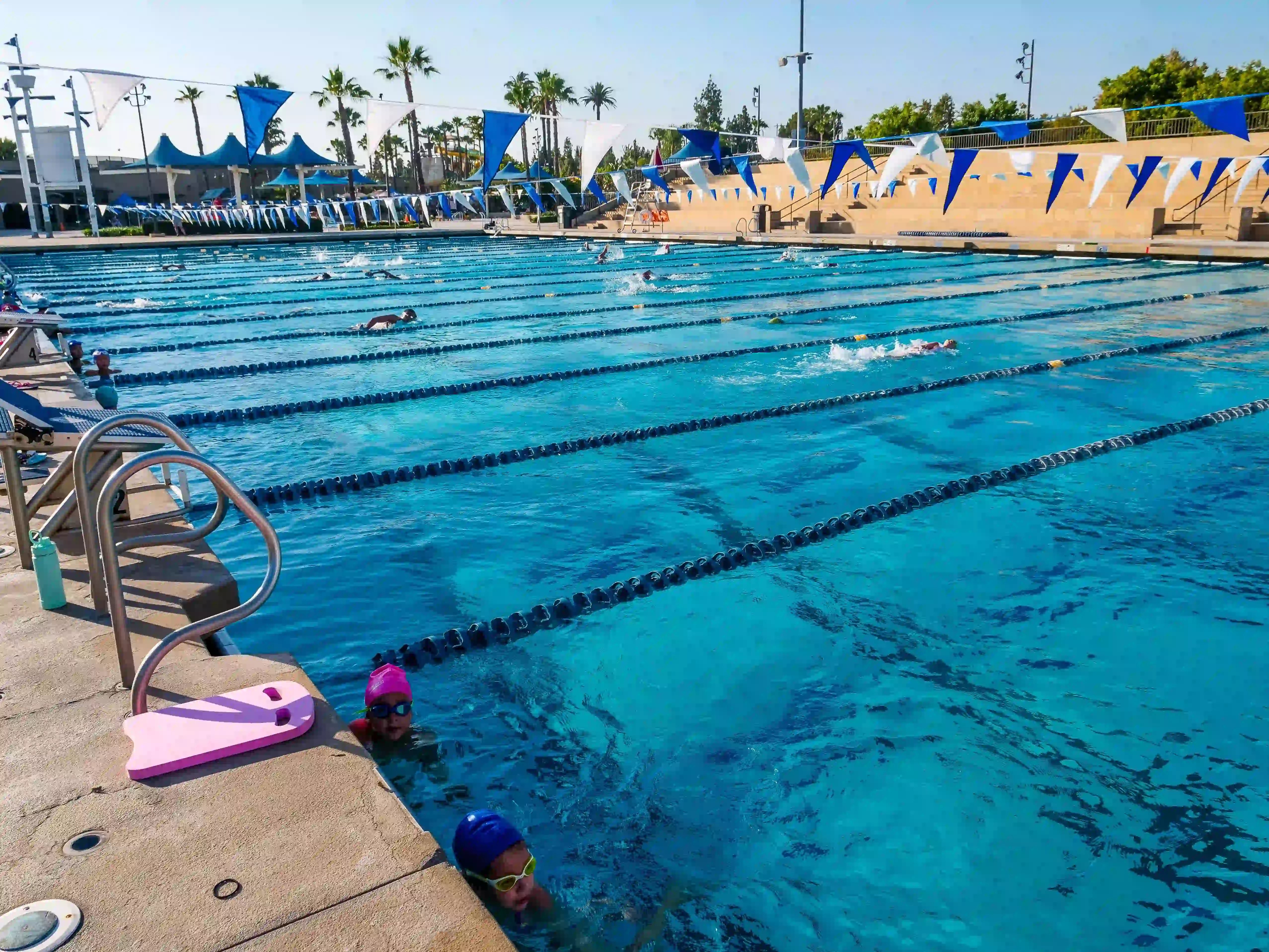
With the Aichi-Nagoya 2026 Asian Games approaching, attention is once again turning toward the engineering precision behind elite aquatic facilities. The swimming events for the 2026 Games will be hosted at the Tokyo Aquatics Centre — originally engineered for the Tokyo 2020 Olympic and Paralympic Games.
As India expands sports infrastructure across smart cities, sports universities, state academies, and premier hospitality developments, an essential question arises for project planners: What does it actually take to build an Olympic-standard swimming pool?
It is far more than pouring concrete into a large basin and filling it with water. A world-class competition aquatic facility integrates structural precision, hydraulic balance, continuous filtration, automated disinfection, water-chemistry controls, and mechanical circulation into a single, continuously operated water treatment plant.
The Global Benchmark: Tokyo Aquatics Centre
The Tokyo Aquatics Centre illustrates how modern competition facilities achieve flexibility through engineering:
Tokyo Aquatics Centre Engineering Highlights
- Main Pool Dimensions: 50 metres × 25 metres with 10 competition lanes
- Adjustable Depth Floor: Movable floor allowing depth changes from 0 to 3.0 metres
- Movable Bulkhead Walls: Configurable into twin 25-metre short-course competition pools
- Diving Pool: 25 metres × 25 metres with a 5.0-metre diving depth
- Sub-Pool (Warm-up): 50 metres × 25 metres certified warm-up and training pool
- International Certification: Certified to World Aquatics (FINA) competition standards
The lesson is clear: the visible dimensions of the pool are only one component of the engineering challenge. The real operational success happens behind the pool walls and inside the plant room.
The 5 Pillars of Competition Pool Engineering
For an Indian project aiming for competition-level certification, engineering teams must plan for five interconnected systems:
1. Pool Structure & Civil Tolerances
A 50-metre competition pool holds approximately 2.5 million litres (2,500 m³) of water. The civil structure must accommodate massive hydrostatic loading, ground settlement, and thermal expansion while maintaining strict millimetre tolerances.
- World Aquatics Tolerances: Finished length between electronic touch pads must measure exactly 50.000 m (± 0.010 m). Even minor waterproofing or tiling variations can disqualify a facility from hosting official record-breaking events.
- Deck-Level Rim Overflow: Perimeter deck-level guttering absorbs swimmer bow waves instantaneously, eliminating turbulence that slows down athletes.
- Plant Room Proximity: Spacious plant rooms engineered for clear pump maintenance access, chemical containment bunds, and adequate ventilation.
2. Precision Hydraulics & Circulation Loop
A competition swimming pool operates as a continuous, closed-loop treatment cycle. Water overflowing into perimeter gutters flows into a surge balance tank, passes through high-efficiency pumps, undergoes filtration, disinfection, and thermal conditioning, and returns evenly through floor-mounted diffusers.
Turnover Period: To ensure uniform water quality, international standards mandate a complete turnover period of 4 to 6 hours. This requires high-capacity circulation pumps moving 400–600 m³/hr, driven by Variable Frequency Drives (VFD) for optimized energy efficiency.
3. Advanced Filtration Systems
Filtration eliminates suspended particulate matter, hair, and organic detritus to ensure absolute water clarity (turbidity < 0.5 NTU). Key filtration arrangements include:
- Pressure Sand Filters (PSF) & Multigrade Media Filters: High-rate graded silica and gravel beds delivering dependable solids removal.
- Dual Media Filters: Combining anthracite and sand to maximize dirt-holding capacity and prolong operational cycles between backwashes.
- Cartridge & Polishing Filters: Sized for sub-pools and dedicated training facilities where fine polishing is required.
4. Automated Disinfection & Chemical Dosing
Clear water must also be hygienically safe water. Heavy bather loads introduce organic compounds that demand automated chemical treatment:
- Primary Disinfectant (Chlorine / Sodium Hypochlorite): Automatically dosed to maintain 0.5 to 1.5 ppm free residual chlorine in alignment with IS 3328 guidelines.
- Secondary Disinfection (UV & Ozone): Destroys irritating chloramines (preventing red eyes and chlorine odors) and neutralizes chlorine-resistant pathogens like Cryptosporidium.
- pH Correction (7.2 – 7.6): Proportional dosing of acid/alkali buffers to protect swimmer skin and prevent pipework corrosion or scale deposition.
5. Water Quality Monitoring & SCADA Automation
Modern athletic venues utilize continuous digital sensors for pH, ORP (Oxidation-Reduction Potential), Free Chlorine, Turbidity, and Temperature (held consistently at 25°C–28°C). Telemetry links directly to BMS and SCADA panels for predictive maintenance alerts and automated backwash scheduling.
Indian Standards (IS 3328) vs. World Aquatics (FINA)
Comparing the Bureau of Indian Standards (BIS) specifications against international competition criteria:
| Parameter | IS 3328:1993 (Indian Standard) | World Aquatics (FINA) Standard |
|---|---|---|
| Dimensions (L × W) | 50.0 m × 21.0 m (min) | 50.000 m × 25.000 m (10 lanes × 2.5 m) |
| Water Depth | 1.0 m to 2.0 m | 2.0 m (min) – 3.0 m (recommended) |
| Water Temperature | Ambient / Controlled | 25.0°C – 28.0°C (strict compliance) |
| pH Range | 7.2 to 7.8 | 7.2 to 7.6 |
| Free Residual Chlorine | 0.2 to 0.5 ppm | 0.5 to 1.5 ppm |
| Turnover Period | 6 to 8 hours | 4 to 6 hours |
| Water Clarity (Turbidity) | < 5.0 NTU | < 0.5 NTU (bottom markers sharp and clear) |
13 Design Considerations Before Project Execution
Before starting civil excavation, engineering consultants and project managers should establish the complete technical basis of design:
| Design Factor | Technical Significance |
|---|---|
| 1. Dimensions & Lanes | Defines total surface area (1,250 m²) and lane layouts. |
| 2. Water Depth & Volume | Establishes hydraulic mass (~2,500 m³) and structural foundation load. |
| 3. Peak Bather Load | Determines oxidant demand, biological load, and chemical dosing sizing. |
| 4. Raw Water Quality | Municipal or borewell supply dictates pre-treatment (iron removal, softening, or RO). |
| 5. Circulation & Turnover | Sizes circulation pumps, balance tanks, and hydraulic pipe diameters. |
| 6. Filtration Media | Controls particulate removal, velocity limits, and water clarity. |
| 7. Disinfection Strategy | Eliminates biological risks, prevents algae, and breaks down chloramines. |
| 8. Chemical Balancing | Regulates Langelier Saturation Index (LSI) to protect tile grout and fittings. |
| 9. Freshwater Makeup | Accommodates daily operational losses (30–50 L/bather/day) from evaporation. |
| 10. Backwash Recovery | Reclaims 80–90% of filter backwash effluent for sustainable reuse. |
| 11. Thermal Control | Maintains 26°C–28°C using energy-efficient heat pumps or solar arrays. |
| 12. Automation & SCADA | Enables remote telemetry, automated backwashing, and safety failsafes. |
| 13. O&M Strategy | Schedules preventive maintenance, sensor calibration, and AMC protocols. |
Water Conservation: Backwash Water Recovery
In water-stressed regions across India, an Olympic pool cannot afford to discard 15,000–30,000 litres of backwash water during filter cleaning cycles.
By implementing an Ultrafiltration (UF) Backwash Recovery System, facilities can recover up to 90% of filter backwash water, polish it to pristine quality, and return it to the balance tank. This substantially lowers municipal water demand, reduces utility costs, and aligns with green building and ESG standards.
The Bigger Picture
The Tokyo Aquatics Centre shows that competition swimming infrastructure is an integrated living engineering system. Built for Tokyo 2020, it continues into the 2026 Asian Games because its water-treatment infrastructure and hydraulics were engineered for long-term operational resilience.
For India, the opportunity is to construct aquatic infrastructure that is technically sound, energy-efficient, and sustainable for decades to come.
Building a competition pool takes concrete, steel, and architectural vision.
Keeping that pool crystal-clear, hygienic, and compliant takes water-treatment engineering.
Planning a Swimming Pool Project?
Connect with Shubham Aqua Vitro for turnkey water treatment engineering, high-rate filtration, automated chemical dosing, and backwash water recycling plants.
References & Standards:
- Tokyo Aquatics Centre — Tokyo Metropolitan Government Sports Facility
- Olympic Council of Asia — Aichi-Nagoya 2026 Asian Games
- Bureau of Indian Standards: IS 3328:1993 — Quality Tolerances for Water for Swimming Pools
- World Aquatics (formerly FINA): Facilities Rules — Swimming Pools Technical Specifications