
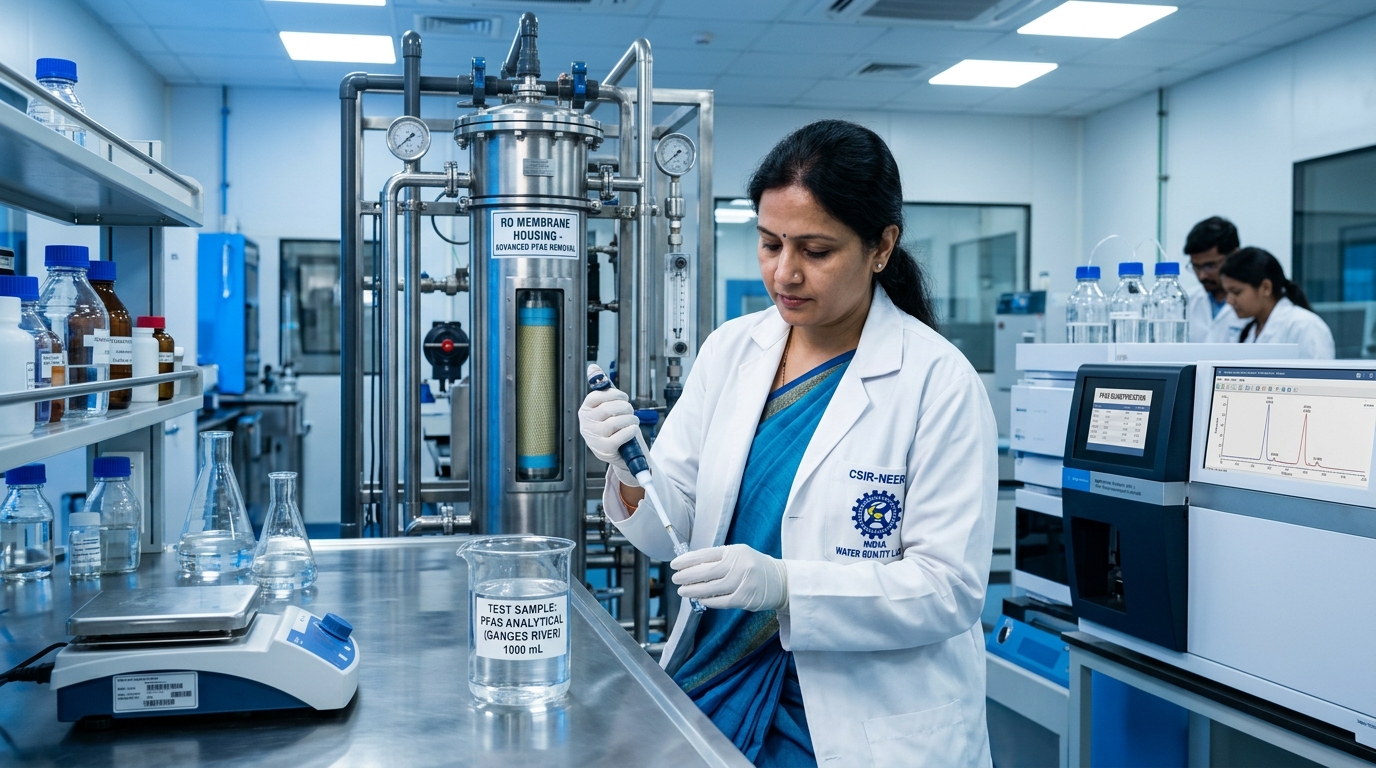
In October 2026, investigative environmental science reporting highlighted a stark reality confronting India’s water infrastructure: conventional water treatment plants are failing to catch PFAS — the so-called “forever chemicals.” In landmark research from IIT Madras, treated drinking water actually contained higher concentrations of certain PFAS compounds than the raw intake water entering the municipal facility.
This article provides an in-depth engineering and regulatory overview: what PFAS molecules are, what recent Indian academic field studies have uncovered, the physiological health risks, why classical sedimentation and filtration processes fail, and why high-rejection Reverse Osmosis (RO) plants are emerging as an indispensable purification barrier.
India currently lacks codified maximum residue limits for PFOA, PFOS, or related PFAS.
IIT Madras study demonstrated higher terminal PFAS in treated water than raw intake.
Thin-film composite polyamide membranes physically block multi-fluorinated molecules.
What Are PFAS (“Forever Chemicals”)?
Per- and polyfluoroalkyl substances (PFAS) represent a class of more than 10,000 synthetic anthropogenic chemical compounds characterized by a carbon backbone entirely or partially surrounded by fluorine atoms.
The carbon–fluorine (C–F) bond is one of the shortest and strongest covalent bonds in chemistry (bond dissociation energy ~485 kJ/mol). This atomic stability confers exceptional chemical inertness, thermal resistance, and surfactant properties — meaning PFAS repel both water and lipids.
Since the mid-20th century, PFAS have been deployed globally across critical manufacturing applications:
- Aqueous Film-Forming Foams (AFFF): Class-B fire-fighting foams utilized extensively at airports, oil refineries, and naval bases.
- Fluoropolymer Non-Stick Coatings: Industrial cookware, chemical reactor linings, and heat-resistant gaskets.
- Water- and Stain-Resistant Textiles: Commercial apparel, upholstery, carpets, and technical membranes.
- Food Packaging Materials: Oil-resistant paperboard, fast-food wrappers, and microwave containers.
- Electroplating & Semiconductor Fabs: Wet chemical etching surfactants and mist suppressants in chrome plating.
Because these molecules resist abiotic hydrolysis, photolysis, and microbial degradation, they do not decompose in landfills or waterways. They migrate seamlessly through soil into alluvial aquifers, accumulating in human blood serum and organs. Two legacy 8-carbon molecules — PFOA (perfluorooctanoic acid) and PFOS (perfluorooctanesulfonic acid) — have been classified by the International Agency for Research on Cancer (IARC): PFOA is designated as carcinogenic to humans (Group 1), and PFOS is classified as possibly carcinogenic (Group 2B).
What Scientific Studies in India Are Showing
While Western jurisdictions (the US EPA and European ECHA) have enacted stringent parts-per-trillion (ppt) thresholds, empirical field investigations across Indian river basins and municipal zones are uncovering ubiquitous contamination:
Key Indian Research Findings
- IIT Madras (2024 Chennai Study): Researchers mapped groundwater, surface canals, and sequential stages of a major metropolitan surface water treatment facility. Groundwater near solid-waste dumpsites yielded the heaviest loads. Shockingly, concentrations of eight target PFAS were 5% to 103% higher in treated water than in the intake reservoir.
- GITAM University (Visakhapatnam Marine Study): Investigating seawater, harbor estuaries, and municipal wastewater discharge for 77 distinct PFAS analytes, researchers detected 38 individual compounds, establishing municipal sewage outfalls as a continuous vector loading coastal zones.
- Pan-India Multi-State Assessment (2025 Review): Environmental reviews spanning industrial catchments in Gujarat, Maharashtra, Tamil Nadu, and West Bengal confirmed that PFAS contamination in industrial groundwater tables is a pervasive, legitimate concern.
- CSIR–IITR Baseline Surveillance: Under a UNEP-supported initiative, CSIR–Indian Institute of Toxicology Research (Lucknow) has initiated specialized mass spectrometry profiling capable of quantifying ~50 PFAS molecules to build national exposure databases.
The fundamental engineering bottleneck is that standard testing labs in India do not possess LC-MS/MS equipment configured for ultra-trace PFAS quantification. Standard commercial test reports issued for IS 10500 conformity simply do not screen for forever chemicals.
The Regulatory Gap: IS 10500 vs Global Standards
India’s principal statutory benchmark, IS 10500:2012 (“Drinking Water Specification”), mandates allowable thresholds for physical attributes, general chemical ions (chlorides, sulfates, hardness), heavy metals (arsenic, lead, mercury), pesticides (DDT, malathion), and bacteriological pathogens. It does not specify a single threshold for PFAS.
| Regulatory Framework | PFAS Limit / Standard | Treatment & Plant Enforcement Implication |
|---|---|---|
| India (BIS IS 10500:2012) | No Limit Specified | Municipal water boards and private industrial plants are not mandated to test or treat for PFAS. Compliance certificates can be issued despite elevated PFOA/PFOS concentrations. |
| US EPA (National Primary Drinking Water Regulation, 2024) | 4.0 parts per trillion (ppt) (PFOA & PFOS enforceable MCL) | Mandates nationwide utility monitoring. Water systems exceeding 4.0 ng/L must install Best Available Technologies: RO membranes, GAC, or specialized ion exchange. |
| World Health Organization (WHO Guidelines) | 100 ng/L Individual / 500 ng/L Total | Advises member states to maintain concentrations as low as reasonably practicable (ALARA) and deploy verified source control and membrane barriers. |
| BIS Working Group (Emerging Contaminants) | Under Active Formulation | Currently drafting standard analytical protocols, screening baseline data from CSIR-IITR, and evaluating prospective limits for upcoming IS 10500 revisions. |
Engineering Takeaway: Waiting for gazetted notification before acting exposes critical institutions — such as hospitals, pharmaceutical formulators, and food processors — to catastrophic product quality risks and retroactive liability.
Why Conventional Water Plants Fail (and Increase PFAS Levels)
Over 90% of municipal and industrial surface-water treatment facilities in India operate on classical treatment trains:
Why does this setup fail so dramatically against PFAS?
- No Particle Adsorption: PFAS molecules are fully dissolved, low-molecular-weight anionic surfactants. Alum and polyaluminum chloride (PAC) coagulants target suspended colloidal turbidity; they do not precipitate dissolved fluorinated carboxylates.
- Precursor Transformation: Raw intake water contains hundreds of unquantified “precursor” chemicals (e.g., fluorotelomer alcohols, polyfluoroalkyl sulfonamides). During aeration, ozonation, or chlorination, oxidative processes break down the oxidizable hydrocarbon segments of these precursors, converting them into ultra-stable terminal compounds — specifically PFOA and PFOS. This directly explains why finished water concentrations in the IIT Madras study surged up to 103% higher than raw water.
- Standard Sand Media Saturation: Silica sand and dual-media filters possess zero affinity or electrostatic binding capacity for highly electronegative fluorine chains. Dissolved PFAS passes straight through the sand bed unaffected.
Proven Engineering Treatment Barriers: How High-Rejection RO Solves the Crisis
Eliminating PFAS from water requires physical separation or molecular destruction technologies. Among all commercial options, Reverse Osmosis (RO) represents the gold standard of validated engineering performance.
Modern thin-film composite (TFC) polyamide reverse osmosis membranes operate with an active polymer separation barrier possessing effective pore dimensions of approximately 0.0001 microns (0.1 nanometers).
Dual Mechanisms of RO PFAS Rejection
- Steric (Size) Exclusion: PFAS molecules possess molecular weights typically ranging from 300 to 600+ Daltons (Da) with kinetic diameters significantly exceeding the sub-nanometer free-volume voids of a cross-linked polyamide active layer. The membrane physically prevents molecular permeation.
- Electrostatic Repulsion (Donnan Exclusion): At typical drinking water pH (6.5–8.5), RO polyamide membranes exhibit a net negative surface charge due to deprotonated carboxylic acid groups. Because terminal PFAS compounds are negatively charged anions (sulfonates and carboxylates), strong electrostatic repulsion deflects the molecules away from the membrane interface into the concentrate stream.
Comprehensive pilot testing confirms that high-rejection brackish water RO (BWRO) elements consistently reject >95% to 99%+ of long-chain PFAS (such as PFOA and PFOS) and >90% of challenging short-chain PFAS (such as PFBA and PFBS), delivering permeate water that easily satisfies global health criteria.
What Indian Industries and Institutions Must Do Now
Facilities requiring high-purity water cannot afford to treat PFAS as a distant theoretical concern:
Facility Action Checklist
Engineered Solutions by Shubham India
At Shubham Aqua Vitro, we engineer, fabricate, and commission turnkey industrial and commercial water treatment plants tailored for India’s most complex feedwater matrices:
- Custom Industrial RO Plants: High-flux, low-fouling brackish water reverse osmosis systems engineered with precision pre-treatment (Pressure Sand Filters, Activated Carbon, and 1-micron cartridge filters) to protect membranes and guarantee >99% solute rejection. Explore our Reverse Osmosis Plant solutions.
- Ultrafiltration (UF) Integration: Hollow-fiber UF systems providing continuous silt density index (SDI < 3) reduction to ensure RO membrane longevity.
- Concentrate Management & ZLD: For industrial facilities with strict zero discharge consent conditions, Shubham provides complete Zero Liquid Discharge (ZLD) solutions integrating high-recovery RO, thermal crystallizers, and MVR evaporators to eliminate liquid effluent entirely.
- Comprehensive Lifecycle Support: Preventive maintenance contracts and membrane autopsy services through AquaCare 360 ensure round-the-clock plant efficiency and compliance readiness.
Primary Scientific References & Authoritative Sources
- The Hindu, “India’s water plants are failing to catch elusive ‘forever chemicals’” (14 October 2026).
- IIT Madras Department of Civil Engineering, Occurrence and Fate of Per- and Polyfluoroalkyl Substances across Chennai Surface Water Treatment Stages (2024).
- GITAM School of Science, Comprehensive Assessment of 77 PFAS in Coastal Urban Waters and Sewage Outfalls of Visakhapatnam, npj Emerging Contaminants (2024–2025).
- Journal of Hazardous Materials Advances, National Review of Per- and Polyfluoroalkyl Substances in Indian Industrial River Basins (2025).
- Bureau of Indian Standards, IS 10500:2012 Drinking Water Specification and Proceedings of the Working Group on Emerging Contaminants.
- US Environmental Protection Agency (EPA), National Primary Drinking Water Regulation for 6 PFAS Compounds (40 CFR Part 141, Final Rule 2024).
- International Agency for Research on Cancer (IARC), Monographs on the Identification of Carcinogenic Hazards to Humans: PFOA and PFOS.
Disclaimer: This article is published for educational and technical engineering guidance and does not constitute formal medical or legal advice. Water plant operators should verify applicable regulatory standards with BIS, the Central Pollution Control Board (CPCB), and State Pollution Control Boards.