India's data center industry is growing rapidly due to artificial intelligence, cloud computing expansion, fintech platforms, digital payments, OTT media streaming, and federal digital infrastructure initiatives. Behind every reliable hyperscale or colocation data center is an equally reliable cooling and water management system.
A water treatment plant for a data center ensures that evaporative cooling systems, chillers, and heat exchangers operate at peak thermal efficiency. By treating intake water, facility operators minimize scale formation, prevent severe equipment corrosion, eliminate biological hazards, reduce unplanned downtime, and meet corporate ESG (Environmental, Social, and Governance) targets.
As hyperscale data center hubs rapidly expand across Tier-1 and Tier-2 Indian tech clusters — including Mumbai, Chennai, Hyderabad, Bengaluru, Pune, Noida, and Ahmedabad — customized water treatment has evolved from an ancillary utility into a strategic infrastructure baseline.
Why Water Treatment Matters for Data Center Infrastructure
Data center cooling infrastructure requires vast volumes of water to reject heat generated by high-density rack servers. Raw or improperly treated water introduced into cooling towers, chillers, and heat rejection loops causes rapid operational degradation. Key hazards of unconditioned water include:
- Scale Formation: Mineral deposits (calcium carbonate, silica) accumulate on heat exchanger surfaces, dramatically impairing heat transfer efficiency and forcing chillers to consume significantly more energy.
- Corrosion: Dissolved gases and aggressive ions degrade metallic piping, condenser tubes, and pump impellers, leading to leaks and expensive asset replacements.
- Microbial Growth & Biofilms: Algae, bacteria, and biofilm proliferation reduce thermal efficiency and pose health risks such as Legionella outbreak in cooling towers.
- Higher Energy Consumption: Thermal resistance caused by even a micro-thin layer of scale forces the cooling plant to work harder, deteriorating the overall Power Usage Effectiveness (PUE).
- Reduced Equipment Lifecycle: Continuous mineral build-up and corrosion shorten the useful operating lifespan of expensive HVAC and chiller assets.
- Unexpected Shutdowns: Thermal throttling or equipment failure directly compromises uptime SLAs (Service Level Agreements) and business continuity.
A properly engineered water treatment plant maintains precise water chemistry, protects capital cooling assets, and drastically lowers total cost of ownership (TCO).
Typical Water Treatment Process Flow for Data Centers
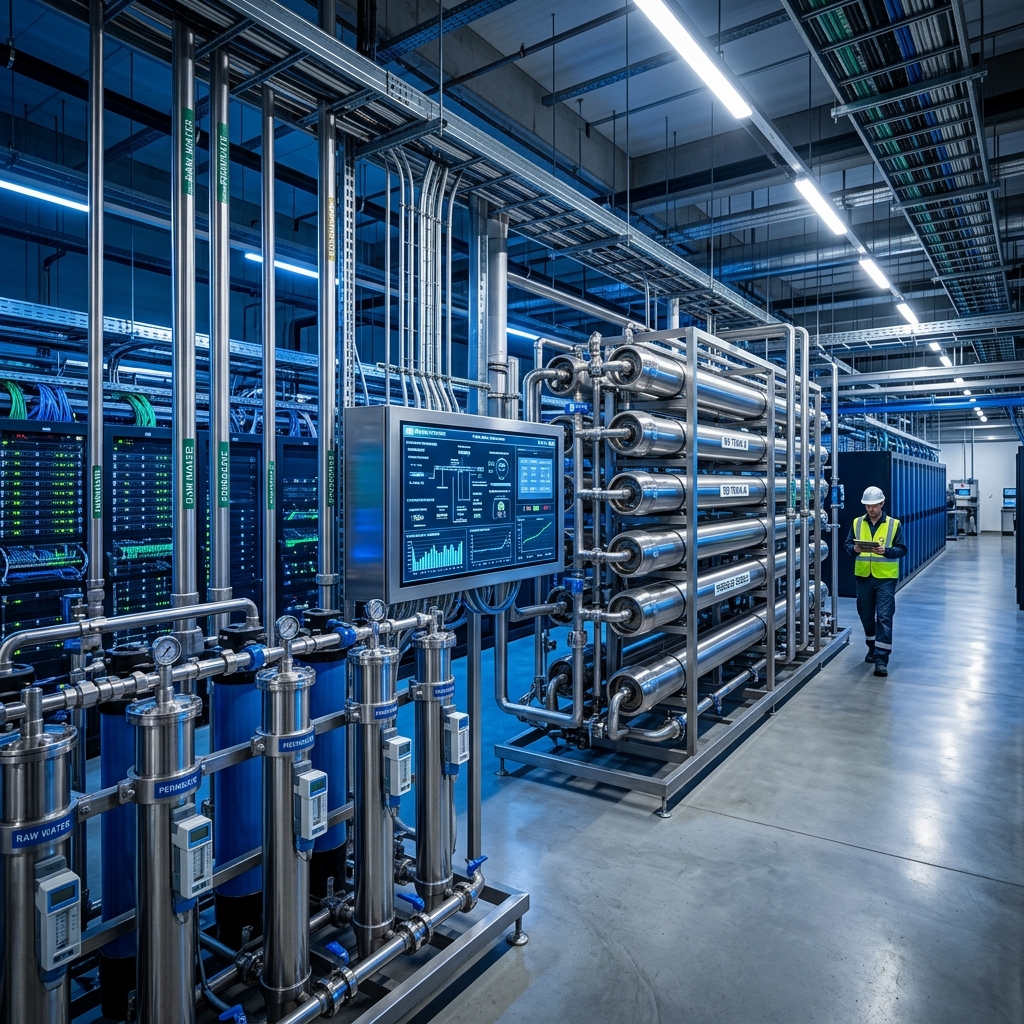
Depending on the raw water source (municipal supply, groundwater borewells, or recycled tertiary effluent), a comprehensive treatment train is implemented to produce feed water tailored to cooling system requirements:
- Raw Water Intake & Equalization: Collecting raw feed water from municipal supply, borewells, or recycled streams to normalize flow and quality parameters.
- Multimedia Filtration (MMF): Trapping suspended solids, silt, and turbidity to protect downstream chemical conditioning and membrane filtration units.
- Activated Carbon Filtration (ACF): Removing residual free chlorine, organic contaminants, color, and odor that could fouling or oxidise sensitive RO membranes.
- Water Softening: Replacing scale-forming calcium and magnesium ions with non-scaling sodium ions through ion-exchange resin softeners.
- Reverse Osmosis (RO) System: Employing high-rejection semi-permeable membranes to eliminate dissolved salts, total dissolved solids (TDS), and heavy minerals. Learn more about Industrial Reverse Osmosis Plants.
- UV & Ozone Disinfection: Destroying waterborne microorganisms, bacteria, and pathogens without introducing residual chemical byproducts into cooling loops.
- Precision Chemical Dosing: Injecting antiscalants, corrosion inhibitors, and non-oxidizing biocides to preserve heat exchangers and pipework.
- Cooling Tower Feed & Side-Stream Filtration: Feeding conditioned water to cooling towers and employing Side-Stream Filters to continuously clarify circulating cooling tower water and maximize Cycles of Concentration (COC).
Indian Market Perspective & ESG Compliance
India’s data center market is witnessing unprecedented growth, driven by data localization norms, cloud transformation, and AI workloads. However, water scarcity across major data center hubs like Chennai, Bengaluru, and Hyderabad presents significant operational challenges.
With heightened focus on ESG ratings, Water Usage Effectiveness (WUE) metrics, and local State Pollution Control Board guidelines, modern Indian data centers are shifting towards sustainable water management. Strategies include:
- Reclaimed & Recycled Water Usage: Utilizing treated municipal sewage or industrial effluent as cooling tower makeup water through advanced ETP and tertiary polishing plants.
- Zero Liquid Discharge (ZLD): Implementing Zero Liquid Discharge systems to recover 95%+ of cooling tower blowdown water for internal re-use, ensuring zero liquid waste generation.
- High Cycles of Concentration (COC): Optimizing water chemistry to increase COC from standard 3–4 cycles to 6–8+ cycles, significantly reducing freshwater makeup demand.
Best Practices for Data Center Water Management
- Continuous Online Monitoring: Install real-time sensors for conductivity, pH, oxidation-reduction potential (ORP), and flow rates connected to SCADA/BMS platforms.
- Custom Site Water Quality Analysis: Conduct comprehensive seasonal water testing to design treatment systems adapted to local water fluctuations.
- Rigorous Preventive Maintenance: Regularly clean media filters, replace cartridge filters, perform RO membrane CIP (Clean-In-Place), and calibrate chemical dosing pumps.
- Integrate Water Treatment early in Facility Design: Collaborate with water treatment specialists during the initial architectural and MEP design phase rather than retrofitting after construction.
Conclusion
Water treatment is no longer optional for modern data centers. A well-engineered water treatment plant improves cooling system reliability, optimizes energy consumption, protects capital equipment, and drives sustainable operations. As Indian data center capacity expands exponentially, integrating advanced water treatment solutions is essential for achieving world-class uptime and sustainability benchmarks.
Looking for a Customized Water Treatment Plant for Your Data Center?
Partner with Shubham Aqua Vitro to design, manufacture, install, and maintain state-of-the-art water treatment systems tailored to your facility's cooling infrastructure, raw water source, and sustainability targets. Explore our Data Center Water Treatment Solutions or contact our technical team today.
Talk to Our Water Treatment Experts